Data & AI Series; Without the Jargon
(An attempt at educating non-techies and Business decision makers on AI-related topics)
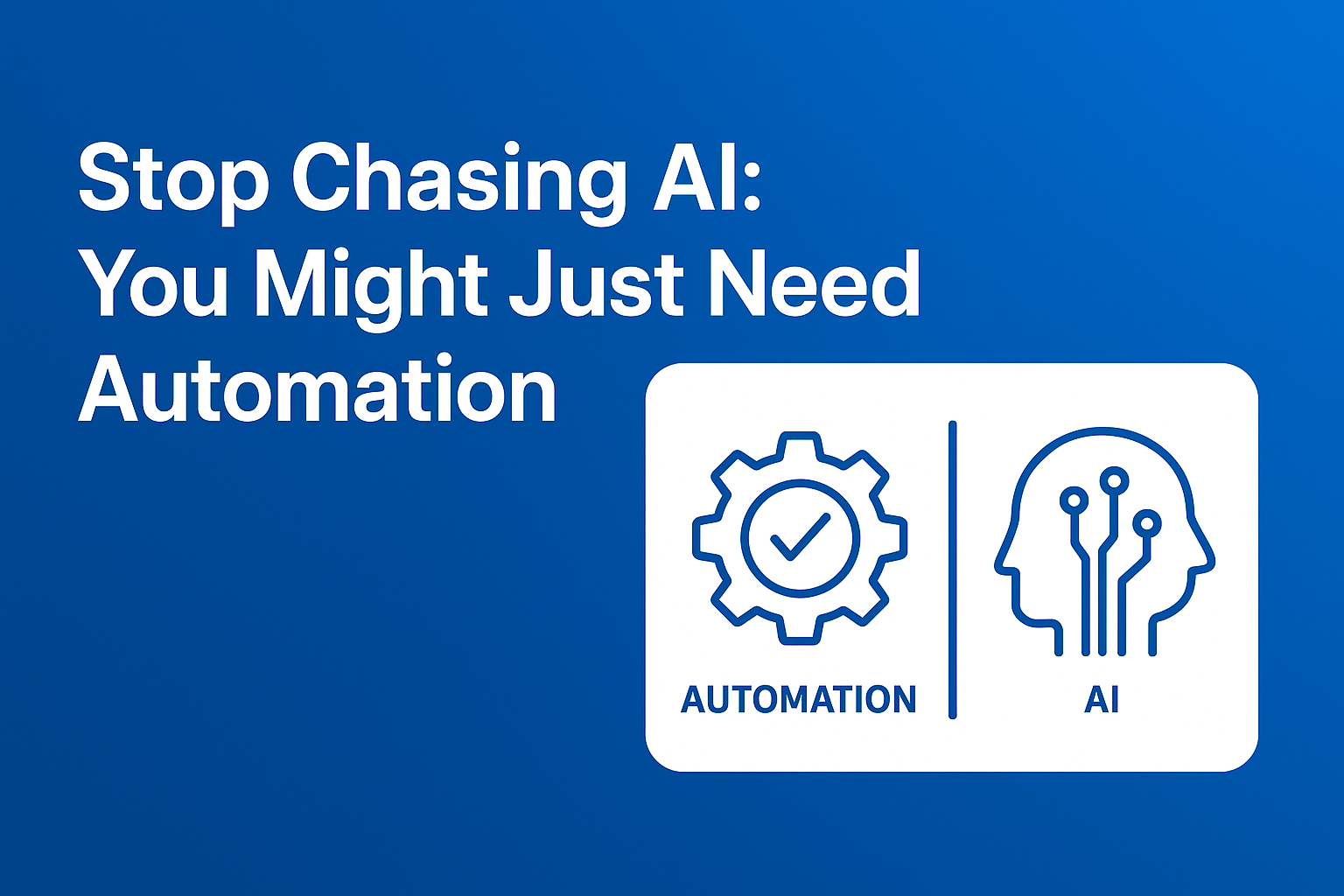
I’ve been immersed in data and AI discussions over the last couple of years, through hands-on projects and continuous self-learning. It’s clear that every business problem these days seems to require an AI solution. It’s the hottest topic everywhere, and because an “AI project” sounds innovative, many leaders are pushing for “AI in all we do.”
However, the more time I spend in this space, the clearer it becomes that AI isn’t the solution every business problem (or process) actually needs.
When You DON’T Need AI
If your process is repetitive, predictable, rule-based, structured, or happens the same way every time—it’s an automation problem. Examples of Automation Problems:
- Pulling weekly reports from a fixed set of sources.
- Notifying teams when a ticket changes status (e.g., from ‘New’ to ‘Assigned’).
- Assigning tasks based on fixed departmental rules.
- Moving data between two systems in a set format.
- Approving expenses that are consistently under a certain monetary threshold.
No AI is required for these tasks. This just needs simple automation and process clarity. I know, “Automation cleanup” sounds boring, but here’s the reality: AI on top of broken processes just speeds up the chaos.
So, When Do I Need AI (Especially Agentic AI)?
AI (and Agentic AI) is useful ONLY when the work involves genuine uncertainty, context, or judgment:
- Interpretation: Reading, classifying, or understanding nuanced meaning.
- Judgment: Deciding between options based on context, not fixed rules.
- Handling Ambiguity: Dealing with inputs that have no clear rules or structure.
- Multi-step Reasoning: Planning and executing multiple sequential steps.
- Dynamic Adaptation: Adjusting behavior when situations change live.
Agentic AI is just a term for AI that can plan, act, adapt, and complete tasks end-to-end—it doesn’t just answer questions; it drives to a conclusion.
Here are the questions to ask before proposing an AI solution:
Is the task repetitive and predictable? → If yes, automation, not AI.
Are there clear rules you can write down?→ If yes, automation.
Does the task require interpretation or judgment?→ If yes, you’re leaning toward AI.
Does the process depend on context or changing conditions?→ Agentic AI might be helpful.
Does the task involve multiple steps that change depending on outcomes?→ Consider agentic AI workflows.
I am the first to admit AI is powerful. But using AI for every problem is like hiring a lawyer to assemble IKEA furniture—it’s expensive overkill. As a business leader, you need to match the right tool to the right problem. Often, the smartest AI strategy… is no AI at all.
Happy to answer any questions you might have. If I don’t know the answer, I’ll happily consult my network of experienced colleagues and friends to get you the right information.
xxxxxxx
Anu Sanya
 Everything Digital Tech and More